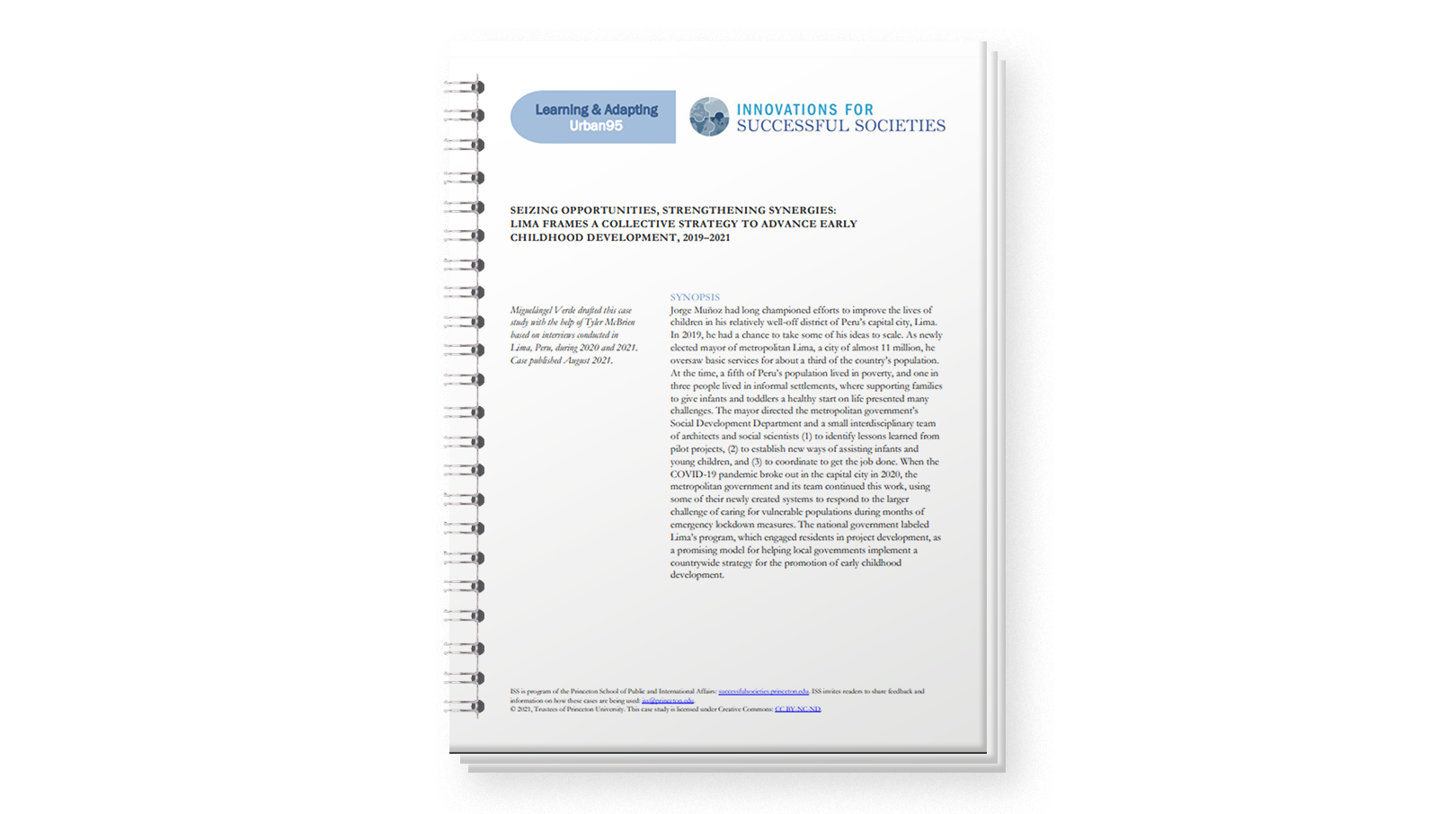
In 2019, Jorge Muñoz had a chance to champion children and take some of his ideas to scale. As newly elected mayor of metropolitan Lima, a city of almost 11 million, he oversaw basic services for about a third of the country’s population.
This case study shows how the mayor directed the metropolitan government’s Social Development Department and a small interdisciplinary team of architects and social scientists (1) to identify lessons learned from pilot projects, (2) to establish new ways of assisting infants and young children, and (3) to coordinate to get the job done. When the Covid-19 pandemic broke out in the capital city in 2020, the metropolitan government and its team continued this work.
The national government labeled Lima’s program, which engaged residents in project development, as a promising model for helping local governments implement a countrywide strategy for the promotion of early childhood development.
We commissioned this case study with Princeton University as part of a series that explores Urban95 implementation from a municipal leadership perspective.
 Management case studies
A Solid Start for Every Child: The Netherlands Integrates Medical and Social Care, 2009−2022
Management case studies
A Solid Start for Every Child: The Netherlands Integrates Medical and Social Care, 2009−2022
 Management case studies
Bridging the Divide: Coalition Building for Early Childhood Development in Istanbul, 2016–2020
Management case studies
Bridging the Divide: Coalition Building for Early Childhood Development in Istanbul, 2016–2020
 Management case studies
Governing from a Child’s Perspective: Recife Works to Become Family Friendly, 2017–2019
Management case studies
Governing from a Child’s Perspective: Recife Works to Become Family Friendly, 2017–2019
 Management case studies
City Hall Embraces Early Childhood Development: Reaching an Underserved Population in Tel Aviv, 2016-2019
Management case studies
City Hall Embraces Early Childhood Development: Reaching an Underserved Population in Tel Aviv, 2016-2019

This collection of seven case studies from Princeton University documents how municipalities have prioritised their youngest residents through Urban95.